
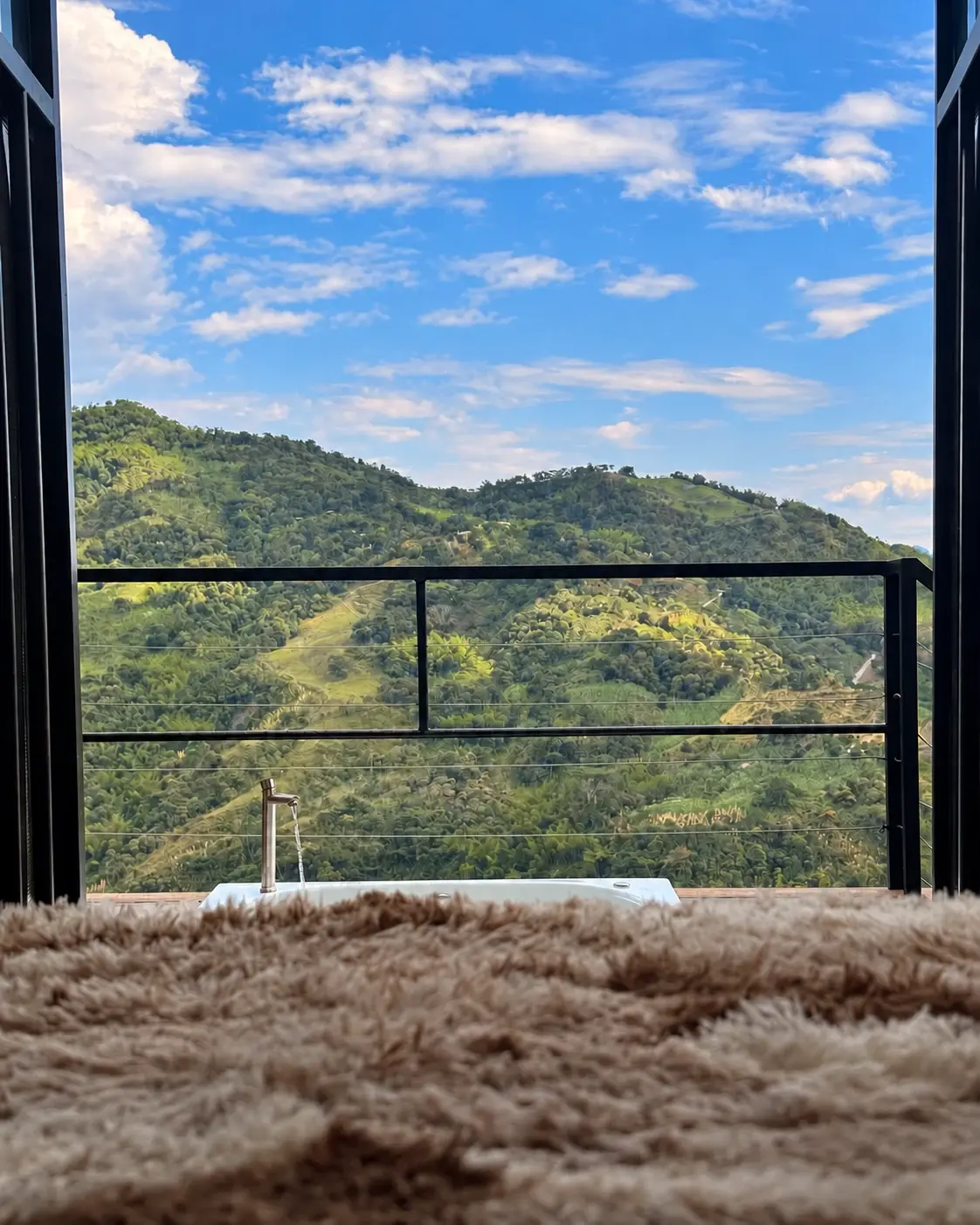
The moment you arrive, something shifts
You have been driving for about 2 hours. The city dissolved somewhere around the first part of the route — the billboards thinned out, the road narrowed into a two-lane curve through hills, and at some point you stopped checking your phone because the signal had quietly faded and you realized you did not mind. Then you turn off the main road, follow a track up through pasture and forest, and the Bagüe cabin appears: tucked into the hillside, windows open to the valley.
That exhale — the one you let out before you have even parked — is what a luxury cabin in Colombia should deliver.
Yaguari Glamping, in El Tigre, Vergara, Cundinamarca, has figured out how to make it happen consistently.
What the Bagüe is, and what it isn’t
The Bagüe is not a rustic experience with thread-count upgrades. It is a cabin designed from the ground up around a single idea: that being in nature should never require suffering. King bed and sofa bed — capacity for four. Hot water that actually runs hot. A private terrace with an outdoor jacuzzi, a swing, and an open-air dining area where the view — the valley, the ridgelines, the shifting afternoon light — is not a backdrop but the entire point.
There is also a catamaran hammock for doing nothing in the best possible way. An equipped kitchen. A private gas grill. A movie projector. The cabin smells like forest because it is in one, and the only sounds at night are the creek below and whatever birds are active at that hour.
There is no television, but a movie projector is included. Streaming can use the cabin cellular 4G modem or a guest phone hotspot. Both depend on mobile carrier coverage, so downloaded content is recommended. The connection is intended for basic use, not demanding work or video calls.
Vergara is the Colombia that didn’t make the guidebook
International travelers tend to move through a fixed circuit: Cartagena, the coffee region, Medellín, Bogotá. All extraordinary. All also heavily trafficked, particularly in high season. Cundinamarca, the department that wraps around the capital, rarely appears on those itineraries — which is precisely what makes it worth seeking out.
Vergara is a small municipality in the Gualivá region, about 2 hours from Bogota on a route combining paved road with a short unpaved section in good condition. The town has a central plaza with old trees and wide, unhurried streets. El Tigre, the vereda where Yaguari sits, is quieter still — the kind of quiet where you hear your own thoughts clearly, which turns out to be either unsettling or deeply restorative depending on how long it has been since you last had access to that.
Colombia’s official tourism portal describes Cundinamarca as one of the country’s most ecologically diverse departments — and one of the least crowded by international visitors.
The cabin is only the beginning
A stay at Yaguari does not require you to do anything. But the terrain around the property is the kind that tends to persuade even committed non-adventurers to put on shoes and go outside.
Independent local operators may provide canopy, rappelling, canyoning and hiking around Vergara. Routes, duration, requirements, availability and inclusions vary; confirm them with the operator before planning your stay.
All of it ends at the cabin. Which, after a morning in the mountains, feels exactly like what luxury means.
The case for doing this sooner than you think
There is a version of this trip where you plan it for months and it becomes an event. And there is a version where you decide on a Thursday, book on a Friday morning, and arrive Friday night in time to eat on the terrace with the valley going dark around you. Yaguari works for both. But the second version — the one where you just go — tends to produce the better stories.